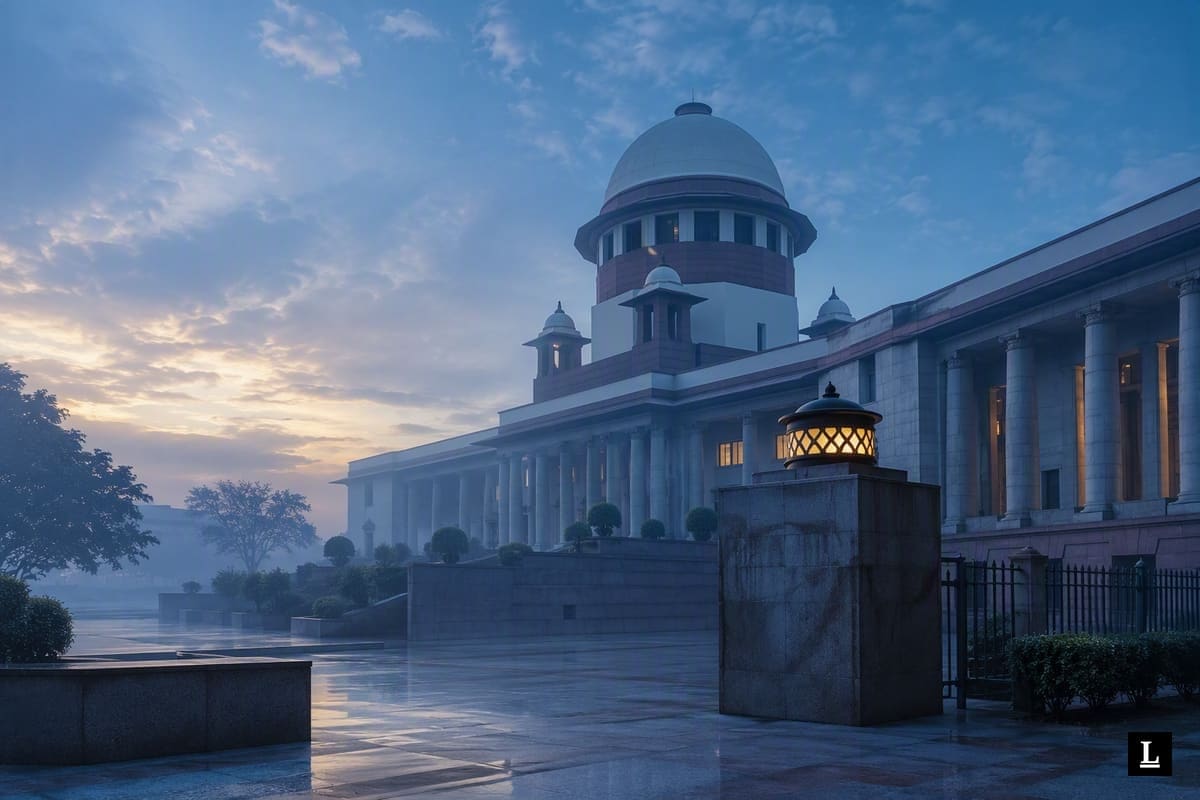
Supreme Court of India
Judicial Appointments: Collegium System Prevails Over NJAC
The Supreme Court of India has affirmed the Collegium System for appointing judges to higher courts, striking down the National Judicial Appointments Commission (NJAC) as unconstitutional. This decision maintains the judiciary's primacy in judicial selections, a principle established through a series of landmark judgments.
 By LuricIO Intelligence

The Supreme Court of India, in a significant ruling, declared the National Judicial Appointments Commission (NJAC) Act, 2014, and the Constitution (Ninety-ninth Amendment) Act, 2014, unconstitutional. This decision effectively restored the Collegium System, where senior judges of the Supreme Court and High Courts recommend appointments and transfers of judges, as the prevailing mechanism for judicial appointments to the higher judiciary. The Court held that the NJAC, with its composition including members from the executive and civil society, infringed upon the independence of the judiciary, which is a fundamental aspect of the basic structure of the Constitution.
Evolution of Judicial Appointments in India
Before 1993, the appointment of judges to the Supreme Court and High Courts was primarily governed by Articles 124 and 217 of the Constitution. These articles stipulated that the President would appoint judges after consultation with the Chief Justice of India and other judges as deemed necessary. While the Chief Justice's opinion was sought, the executive held significant sway in the final decision. This system led to concerns about executive influence over judicial appointments.
The landscape shifted with the Supreme Court Advocates-on-Record Association v. Union of India (1993), famously known as the Second Judges Case. The Supreme Court interpreted the term "consultation" in Articles 124 and 217 to mean "concurrence," thereby establishing the primacy of the Chief Justice of India's opinion. This judgment laid the foundation for the Collegium System, where a body of senior Supreme Court judges would recommend appointments. This was further refined in the Special Reference No. 1 of 1998 (Third Judges Case), which clarified that the Collegium for the Supreme Court would comprise the Chief Justice of India and the four senior-most judges, and for High Courts, the Chief Justice and two senior-most judges of that High Court, in consultation with the Chief Justice of India.
The Collegium System
Under the Collegium System, the Chief Justice of India and the four senior-most judges of the Supreme Court make recommendations for appointments to the Supreme Court and for the transfer of High Court judges and Chief Justices. For High Court appointments, the Collegium consists of the Chief Justice of the High Court and its two senior-most judges, who consult with the Chief Justice of India and two senior-most Supreme Court judges. The recommendations are then forwarded to the executive for approval. While the executive can seek clarification or reconsideration, if the Collegium reiterates its recommendation, the executive is generally bound to accept it. The system aims to ensure judicial independence by keeping appointments within the judiciary.
The National Judicial Appointments Commission (NJAC)
In response to criticisms of the Collegium System, particularly its perceived lack of transparency and accountability, the Parliament enacted the Constitution (Ninety-ninth Amendment) Act, 2014, and the National Judicial Appointments Commission Act, 2014. These legislations sought to replace the Collegium System with the NJAC. The NJAC was proposed as a six-member body comprising:
- The Chief Justice of India (Chairperson)
- Two senior-most Supreme Court judges
- The Union Minister of Law and Justice
- Two eminent persons (to be nominated by a committee consisting of the Prime Minister, the Chief Justice of India, and the Leader of Opposition in the Lok Sabha).
The NJAC was intended to bring greater transparency and a more diverse perspective to judicial appointments, involving both the judiciary and the executive.
The Supreme Court's Verdict on NJAC
The constitutional validity of the NJAC was challenged before the Supreme Court. In Supreme Court Advocates-on-Record Association v. Union of India (2015), also known as the Fourth Judges Case, a five-judge Constitution Bench, by a 4:1 majority, struck down both the Constitution (Ninety-ninth Amendment) Act, 2014, and the National Judicial Appointments Commission Act, 2014. The Court observed that the inclusion of the Union Law Minister and two eminent persons (who could be influenced by the executive) in the NJAC compromised the judiciary's independence. The majority held that judicial independence is a part of the basic structure of the Constitution and that the NJAC's composition undermined this fundamental principle. The Court also noted that the NJAC's provisions, particularly the veto power given to any two members, could allow the executive to block judicial appointments, thereby eroding judicial autonomy.
Current Position and Criticisms
Following the striking down of the NJAC, the Collegium System remains the operative mechanism for judicial appointments. The Supreme Court, while restoring the Collegium, acknowledged the need for improvements in its functioning, particularly regarding transparency and eligibility criteria. It invited suggestions for improving the Collegium System, which led to the formulation of a Memorandum of Procedure (MoP) that is still under discussion between the judiciary and the executive. Despite its continuation, the Collegium System continues to face criticism for its opaque nature, lack of clear selection criteria, and potential for nepotism, while proponents argue it is essential for maintaining judicial independence from political interference.
Have a question on this?
Ask LuricIO AI about this judgement, the provisions involved, or your own matter, and get a court-ready answer.
An evergreen explainer by LuricIO Intelligence on a landmark judgement or key provision of Indian law. Always confirm the current statute and the latest authorities against the official record.
An AI-generated explainer by LuricIO Intelligence on a key provision or landmark judgement of Indian law. It may contain errors and is not legal advice, independently verify the current statute and the latest judgements against the official record before relying on it.
Related analyses
See all in Supreme CourtSupreme Court of India
Supreme Court Advocates-on-Record Association v. Union of India (1993): Genesis of the Collegium System
3 min read
Supreme Court of India
Supreme Court Orders CISF Cover in Temple Deepam Row
4 min read
Supreme Court of India
D.K. Basu Custodial Safeguards Under the BNSS
4 min read

Supreme Court of India
Supreme Court Defers Rape Conviction Appeal Hearing
5 min read
