Supreme Court of India
E.P. Royappa: Redefining Equality as the Antithesis of Arbitrariness under Article 14
The landmark judgment of E.P. Royappa v. State of Tamil Nadu (1974) fundamentally reshaped the understanding of Article 14, moving beyond mere classification to establish that equality is inherently antithetical to arbitrariness. This ruling laid the groundwork for a broader interpretation of the right to equality, impacting all state actions.
 By LuricIO Intelligence
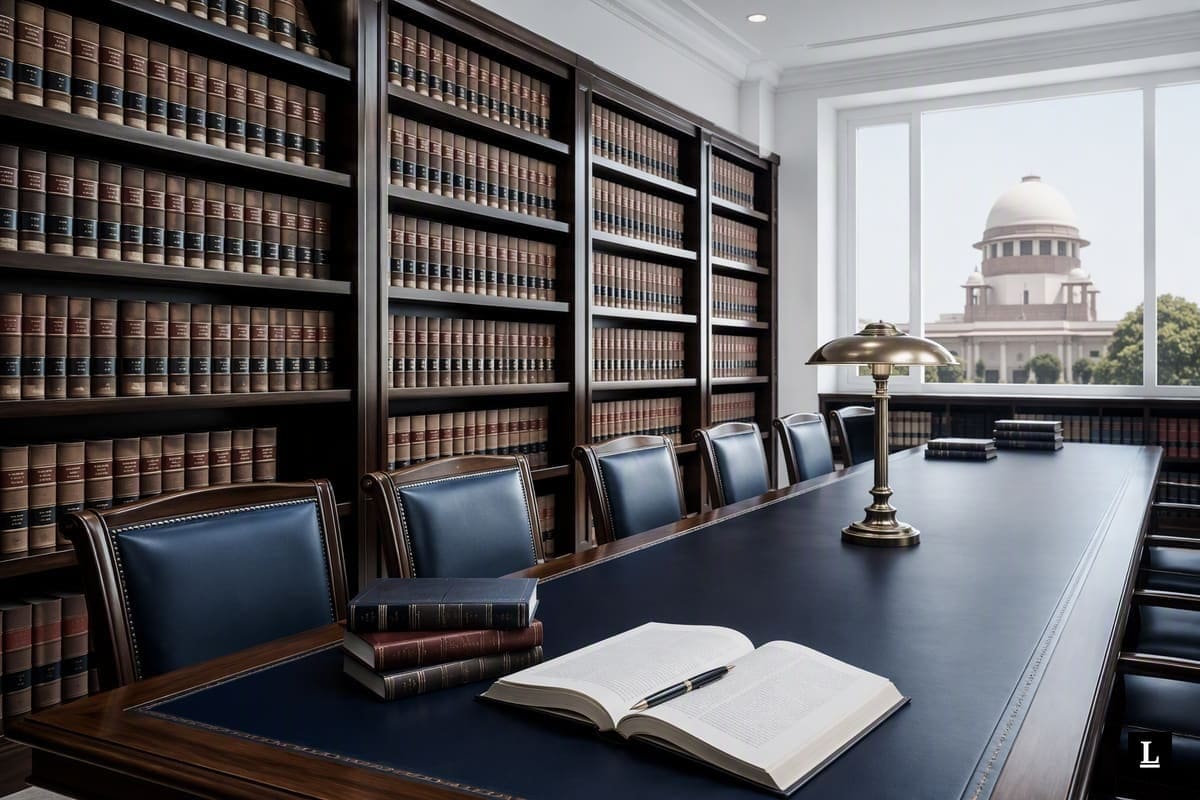
The Supreme Court in E.P. Royappa v. State of Tamil Nadu (1974) 4 SCC 3 delivered a pivotal judgment that expanded the scope and meaning of Article 14 of the Constitution of India, declaring that equality is a dynamic concept and is antithetical to arbitrariness. This decision moved the interpretation of Article 14 beyond the traditional 'reasonable classification' test, establishing that any state action that is arbitrary is inherently unequal and thus violative of the right to equality.
The Genesis of the New Doctrine
Prior to E.P. Royappa, the judicial interpretation of Article 14 primarily revolved around the 'doctrine of reasonable classification'. This doctrine, articulated in cases like State of West Bengal v. Anwar Ali Sarkar (1952) SCR 284, held that Article 14 forbids class legislation but permits reasonable classification, provided it satisfied two conditions: an intelligible differentia distinguishing persons or things grouped together from others left out of the group, and a rational nexus between the classification and the object sought to be achieved by the legislation. While this test provided a framework for assessing legislative action, it often proved inadequate in addressing arbitrary executive actions that did not involve explicit classification.
The case of E.P. Royappa concerned a dispute over the transfer and appointment of an Indian Administrative Service (IAS) officer. While the specific facts related to service law, it was Justice P.N. Bhagwati's concurring opinion that introduced a revolutionary perspective on Article 14. He famously stated, "Equality is a dynamic concept with many aspects and dimensions and it cannot be 'cribbed, cabined and confined' within traditional and doctrinaire limits. From a positivistic point of view, equality is antithetic to arbitrariness. In fact, equality and arbitrariness are sworn enemies; one belongs to the rule of law in a republic while the other, to the whim and caprice of an absolute monarch." This dictum fundamentally redefined the scope of Article 14, asserting that any arbitrary state action, irrespective of whether it involves classification, would violate the guarantee of equality.
Evolution and Application of the Doctrine
The principle laid down in E.P. Royappa was subsequently affirmed and significantly expanded by the Supreme Court in Maneka Gandhi v. Union of India (1978) 1 SCC 248. In Maneka Gandhi, the Court held that the procedure established by law under Article 21 (protection of life and personal liberty) must be fair, just, and reasonable, and not arbitrary, fanciful, or oppressive. This judgment effectively integrated the non-arbitrariness standard of Article 14 into the heart of procedural due process under Article 21, establishing an interrelationship between Articles 14, 19, and 21.
Further solidifying this doctrine, the Supreme Court in Ajay Hasia v. Khalid Mujib Sehravardi (1981) 1 SCC 722 reiterated that Article 14 strikes at arbitrariness in state action and ensures fairness and equality of treatment. The Court held that any action that is arbitrary must necessarily involve the negation of equality. This case also expanded the definition of 'State' under Article 12, bringing entities that are instrumentalities or agencies of the government within the ambit of constitutional obligations, including adherence to Article 14.
Limits and Contemporary Relevance
The arbitrariness doctrine has become a powerful tool for judicial review, allowing courts to scrutinize executive and administrative actions for fairness and reasonableness. It ensures that public authorities act in a non-arbitrary, rational, and just manner. However, the application of this doctrine is not without its nuances. Courts must balance the need to prevent arbitrary action with the principle of judicial restraint, avoiding interference in policy matters unless the executive action is manifestly arbitrary or irrational. The doctrine continues to evolve, influencing various aspects of public law, including public employment, administrative discretion, and the validity of statutory provisions. It serves as a constant reminder that the rule of law, and not the whim of individuals, must govern all state actions.
Historically, Article 14 was interpreted through the 'reasonable classification' test, which allowed differential treatment if based on a rational distinction. The E.P. Royappa judgment marked a paradigm shift, introducing the 'non-arbitrariness' principle as an independent facet of equality. This evolution, further cemented by Maneka Gandhi and Ajay Hasia, transformed Article 14 into a robust guarantee against all forms of arbitrary state action, ensuring substantive equality and fairness.
This doctrine means that any action taken by the government or its agencies must be fair, reasonable, and non-arbitrary. If a citizen feels that a government decision or policy affecting them is arbitrary or unreasonable, they can challenge it in court under Article 14. This provides a crucial safeguard against misuse of power and ensures that individuals are treated equally and justly by the state.
Have a question on this?
Ask LuricIO AI about this judgement, the provisions involved, or your own matter, and get a court-ready answer.
An evergreen explainer by LuricIO Intelligence on a landmark judgement or key provision of Indian law. Always confirm the current statute and the latest authorities against the official record.
An AI-generated explainer by LuricIO Intelligence on a key provision or landmark judgement of Indian law. It may contain errors and is not legal advice, independently verify the current statute and the latest judgements against the official record before relying on it.
Related analyses
See all in Supreme CourtSupreme Court of India
Supreme Court Refuses to Monitor Cauvery Water Release
4 min read

Supreme Court of India
Society Tag No Shield From Article 12: Supreme Court
3 min read

Supreme Court of India
SC Declines Urgent Hearing on Festival Airfare Hikes
4 min read

Supreme Court of India
SC: Voter Awareness Is Not Election Body Monopoly
4 min read
